Monday, July 30, 2012
Tuesday Poem: Weapons Grade by Terese Svoboda
I am up to my neck in American Terese Svoboda's writing this week because I'm chairing a session with her at Writers on Monday next week August 6, 12.15 pm in the Marae at Wellington's Te Papa.
Her collection of poetry Weapons Grade calls out insistently in its yellow jacket and skull-masked face -- check out one of the poems here, but I am also in the middle of Trailer Girl - the collection of her short fiction and there are the essays still to go.
Svoboda's novel Bohemian Girl, I have finished - exhilarated. It is, quite simply, beautiful. Check out the book trailer,
And this is just the tip of the iceberg. Svoboda is prolific and brilliant in a range of genres - go here to see how much. Frightening really.


Thursday, July 26, 2012
What Rhymes with Wairarapa? Poets hit the road.

I'll be reading from The Tenderness of Light which is a chapbook written about our place near Martinborough published earlier this year. Come along if you're in the area. Carterton Library at 10, Masterton Library at 12.15, Wairarapa college at 2.05 and Aratoi in Bruce Street Masterton at 7 pm.
Oh and we're still looking for words that rhyme with Wairarapa on our Facebook page (thanks to those who have so generously contributed!) or you could pop some in the comments below. We hope to use them on the day... create a crazy rap ... or something!
Here's a start:
Bug zapper, faultline mapper, rapper, trapper, handicapper, army sapper, whippersnapper, wanna cuppa? how's your papa?
Tuesday, July 24, 2012
Tuesday Poem: The Landscape
My father serves lunch, lifts
the salad with servers, offers
a dish of olives,
the muted light stroking his
hands, head bent as if
in a pew, paler
than I think of him.
On the pergola
above, the leaves of the vines
are ecstatic and lime-bright,
a scribble of veins,
tendrils, shadows – a reminder how light
both clarifies and complicates –
how a simple landscape of skin, let’s say,
can become a whole atlas.
Here the x-ray,
there the scan.
The chickens
pant in the hedge.
He chops bread
and chunks of cheese, lays
one on the other
passes it across the table
to my mother,
his hand a plate. She’s feeling
the heat, longs to be cool
inside with a book, is looking
up, grateful
for the vines, for the lean of the tree
beside us, its pollen rising rapidly like small fish
in a vertiginous sea.
The olive dish
is passed around again. My father
sweeps crumbs
onto the grass with his hand. (He asks
the surgeon now and then, ‘When it comes
again how will I know?’) All this
light and still the incomprehensible
scrabble of things,
dark scribbles
that dim
the bright falling. Above,
the sky’s open palm,
supplicating leaves.
By Mary McCallum
Post updated 12:01 pm Tuesday July 24 - more on Mahy.
This poem is from my small book The Tenderness of Light out earlier in the year which I'll be reading from in the Wairarapa this Friday as part of a poetry roadshow with four other poets for National Poetry Day. Do come if you're in the area! Details here.
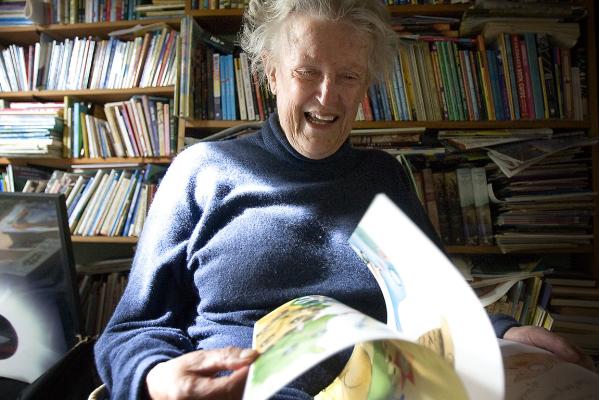
The Landscape is written about my parents, but I'll dedicate it here to Margaret Mahy, the astonishing children's writer who died from cancer yesterday in Christchurch.
Her gift to readers is immeasurable. Her books are a joyful and magical part of so many lives, mine and my children's included. What would we have been without A Lion in the Meadow? And Maddigan's Quest?
I met her once, she signed our treasured copy of A Lion in the Meadow. My mother met her too - she had to pick her up from Wellington station over 20 years ago, to take her to a reading at Newtown library where Mum worked.
Mahy used to wear an orange curly wig to perform for children and you can imagine the writer's delight when she saw Mum's car: a bright orange Fiat Bambina with a sunroof. She leapt in, donned her wig, pulled back the sunroof and sailed through Wellington like that.... my Mum grinning all the way.
Update: My daughter has just reminded me how, smitten by Maddigan's Quest when she was ten, and keen on writing herself, she sent Margaret Mahy a letter. She received a long handwritten letter in return that amongst other things said that she, Margaret Mahy, liked the same character Issy liked, and encouraging Issy to write down her stories too. When I told Issy this morning that Mahy had died, she burst into tears.
The Booksellers NZ blog has posted The Fairy Child today - a perfect choice. It begins: 'The very hour that I was born/I rode upon a unicorn' - yes! she did! God Bless the extraordinary people in our midst who ride unicorns - and ride them to our very door - and ask us to climb aboard.
Margaret Mahy, you will be sorely missed.

Oh and please do visit our magical Tuesday Poem hub today to see poems from each of the NZ Book Awards finalists selected by Andrew Bell. An uplifting way to start the day.
the salad with servers, offers
a dish of olives,
the muted light stroking his
hands, head bent as if
in a pew, paler
than I think of him.
On the pergola
above, the leaves of the vines
are ecstatic and lime-bright,
a scribble of veins,
tendrils, shadows – a reminder how light
both clarifies and complicates –
how a simple landscape of skin, let’s say,
can become a whole atlas.
Here the x-ray,
there the scan.
The chickens
pant in the hedge.
He chops bread
and chunks of cheese, lays
one on the other
passes it across the table
to my mother,
his hand a plate. She’s feeling
the heat, longs to be cool
inside with a book, is looking
up, grateful
for the vines, for the lean of the tree
beside us, its pollen rising rapidly like small fish
in a vertiginous sea.
The olive dish
is passed around again. My father
sweeps crumbs
onto the grass with his hand. (He asks
the surgeon now and then, ‘When it comes
again how will I know?’) All this
light and still the incomprehensible
scrabble of things,
dark scribbles
that dim
the bright falling. Above,
the sky’s open palm,
supplicating leaves.
By Mary McCallum
Post updated 12:01 pm Tuesday July 24 - more on Mahy.
This poem is from my small book The Tenderness of Light out earlier in the year which I'll be reading from in the Wairarapa this Friday as part of a poetry roadshow with four other poets for National Poetry Day. Do come if you're in the area! Details here.
 |
| by Kirk Hargreaves Fairfax/NZ |
Her gift to readers is immeasurable. Her books are a joyful and magical part of so many lives, mine and my children's included. What would we have been without A Lion in the Meadow? And Maddigan's Quest?
 |
| Fairfax/NZ |
Mahy used to wear an orange curly wig to perform for children and you can imagine the writer's delight when she saw Mum's car: a bright orange Fiat Bambina with a sunroof. She leapt in, donned her wig, pulled back the sunroof and sailed through Wellington like that.... my Mum grinning all the way.
Update: My daughter has just reminded me how, smitten by Maddigan's Quest when she was ten, and keen on writing herself, she sent Margaret Mahy a letter. She received a long handwritten letter in return that amongst other things said that she, Margaret Mahy, liked the same character Issy liked, and encouraging Issy to write down her stories too. When I told Issy this morning that Mahy had died, she burst into tears.
The Booksellers NZ blog has posted The Fairy Child today - a perfect choice. It begins: 'The very hour that I was born/I rode upon a unicorn' - yes! she did! God Bless the extraordinary people in our midst who ride unicorns - and ride them to our very door - and ask us to climb aboard.
Margaret Mahy, you will be sorely missed.
Oh and please do visit our magical Tuesday Poem hub today to see poems from each of the NZ Book Awards finalists selected by Andrew Bell. An uplifting way to start the day.
Tuesday, July 17, 2012
Tuesday Poem: Fuck You by John Adams
I'm editor of the Tuesday Poem hub this week and have the pleasure of posting a poem by John Adams whose collection Briefcase won the Best First Book of Poetry Award. Please go and see...
Wednesday, July 11, 2012
Mansfield with Monsters at 1000 wpm
My review of Mansfield with Monsters by Katherine Mansfield and Matt and Debbie Cowans (Steam Press 2012). A great literary mash-up - enjoyed reading it immensely.
My review sounds like it's been speeded up a bit, but that's just me when I'm excited ( the book) - tired (long story) - and haven't (mistakenly) eaten any breakfast.
I have to say, I had a delicious lunch shortly afterwards at the fabulous Haya on Aro St : mini meatloaf, salad and homemade focaccia. Slowed me right down. After that, my band had a practice - much mellower all round.
Tuesday, July 10, 2012
Tuesday Poem:Clicks
Okay, I lied. This isn't a poem exactly although it has the stuff of a prose poem about it. It's a Flash Fiction story I entered in the recent National Flash Fiction Day competition.
It didn't win. Oddly enough someone called Janis was a runnerup for the national prize and then won the Wellington regional one, so you could say I was onto a winning idea at least! Might even shimmy along for a while on her fabulous coat tails... (I should say I did not in any way have this Janis in mind when I wrote about Janis and Tommy and their little problem.)
Congrats to you Janis Freegard (also a Tuesday Poet) - I'm really looking forward to reading your story, I know it will be a treat - and to the other winners, bravo. Here's mine...
Clicks
Janis made him listen to the clicking sounds in the kitchen
wall. They stood face to face, their noses almost touching. He could smell the
Brussels sprouts she’d eaten for dinner. Her lips were tight on her teeth when
she spoke.
‘What is it?’ she said.
He listened. It was silent at
first, then there was a small click, and another. ‘It’s nothing.’
Janis emitted a click of her own.
‘It’s not nothing, Tommy, but I can’t think about it now. I’ve got work
tomorrow. I’m off to bed.’
It was three days of this before he
got the electrician in. The wiring was fine, it seemed, but mice were
mentioned. Tommy went out and bought traps and a tin of poison. He laid them
strategically then poured himself an early beer. They didn’t listen to the walls that night, and Janis laughed
at something on TV. When her mouth was relaxed, it reminded him of that actress
in Friends.
A
week of traps and he didn’t catch one mouse. The clicks were louder and more
frequent and Janis spoke stiffly again. She said that Bill at work had borer, and then she went off to read in the bedroom.
The
next day, Tommy bought a pest bomb. He sat smoking outside while it did its
thing, but afterwards the clicks were even more frenetic. They made him think of
Janis typing up his CV for the job applications. She was Jennifer Aniston every
day back then. He called her Janiston for laughs. Her hair smelt of frangipani.
Tommy
got the axe from the garage. It didn’t take long to demolish the wall, and the
ones either side for good measure. Then he waited, one
thumb on the blade, the other clicking time with the clock.
Mary McCallum
Monday, July 9, 2012
Zombies and Mansfield and me
 |
| Zombies - nothing to do with KM - it's a short film my daughter (centre, white jacket) is in called A PARTY FOR ME (dir. Amy Brosnahan) |
I have been reading Mansfield you see - but not via the usual route. The book I am close to finishing is Mansfield with Monsters (Steam Press) to review on Wednesday on Nine to Noon (Radio NZ). These are Katherine Mansfield's classic stories but with the gothic/troubled element developed by authors Matt and Debbie Cowens via zombies and vampires and other beings of the horror genre. I know, weird. But I'm enjoying it! The version of The Doll's House in here will not allow me to read 'I seen the little lamp' the same way again.
It's been bliss reading KM's marvellous language again, fun to try out this zombie stuff (not my usual milieu), and then there's the added pleasure of digging out my copies of her original stories and enjoying those too - the ones I know and the ones I don't.
More language tumbling about me this week ...in the form of tantalising extracts of Kirsty Gunn's new novel The Big Music out there on the internet (see previous blogpost) and I see there was a rave review in The Independent this weekend calling The Big Music a masterpiece! Fantastic.
And there's more. I have finished my children's book. I thought I had finished it a couple of month's back, I told a few close friends and my children so, but I couldn't quite let it go (another bad habit). I let it sit on the computer here. Popped in and out. Fiddled. Yesterday. Done. I can't quite believe it (which is probably why I've buried the announcement in the middle of a post).
I have also finished a short story to share with my lovely local writing group tonight. It's been sitting on file for 25 years - weirder and weirder - and troubling me for some time. I loved it as it was but no-one else did that I showed it to. I started revamping it for the Grimm fairy tale competition (rewrite one of the classic fairy tales as a modern tale) but failed to get it done in time (fancy that).
I believe the new version is better, although the old story is ghostlike behind it... and having read KM's Bliss this weekend, I realise that what I had before was something that had that sort of rush of unmanageable feeling about it - I hadn't thought that until now - while the new story doesn't, is more prosaic somehow, but despite that, is more engaging emotionally? Anyway, I'll be interested to see what the group thinks.
It just shows what a writing group can do. Deadlines and expectations are good for me. Trust, too - we trust each other with our work: drafts, meanderings, rewrites .... There are seven of us - men and women - ranging in age from 40s to 80+ and writing a range of genres including spy thriller, horror, children's fiction, creative non-fiction, literary fiction, poetry, memoir... with half of us shifting around between those genres from week to week and the other half sticking to ongoing projects. We meet monthly and we have a meeting tonight. I am so looking forward to it.
Meanwhile, I guess I should get dressed and walk the dog. In its own way, bliss.
Thursday, July 5, 2012
More than a book, it's a feeling - Kirsty Gunn's The Big Music launched
"The hills only come back the same: I don’t mind, and all the flat moorland and the sky. I don’t mind they say, and the water says it too, those black falls that are rimmed with peat, and the mountains in the distance to the west say it, and to the north . . . As though the whole empty wasted lovely space is calling back at him in the silence that is around him, to this man out here in the midst of it, in the midst of all these hills and all the air. That his presence means nothing, that he could walk for miles into these same hills, in bad weather or in fine, could fall down and not get up again, could go crying into the peat with music for his thoughts maybe, and ideas for a tune, but none of it according him a place here, amongst the grasses and the water and the sky . . . Still it would come back to him the same in the silence, in the fineness of the air . . . I don’t mind, I don’t mind, I don’t mind.
"Is what there is to begin with, a few words and the scrap of a tune put down for the back of the book in some attempt to catch the opening of the thing, how it might start. With this image of a man, born 83 years ago down out of these same hills, and how he might think now how the land doesn’t mind him, never has. Here he is walking in up the strath towards that far bend in the river and the loudest note could sound in his head and him follow it with a sequence and still this country, his country, would keep its own stillness and only give back to him the louder quiet, like the name of the tune itself could be I don’t mind, is what he’ll call it, ‘Lament for Himself’.[1]"
It is more than a book, too, this book -- it is the inspiration for the film made by Gary M Gowers, for the 'Pebroch' bagpipe music written by her father (heard on the film), for an art installation created by her sister Merran. Hear Kirsty and Merran and Gary talking about the project below. For more on Kirsty, her book events, a longer extract from her book go here. If you're pondering whether or not to investigate this book further. Read the reviews below. I am in no doubt that as with her other novels, The Big Music is more than a book, it is a feeling, a thing, an experience.
“More than a dappled tale, an allegory, or history, The Big Music is a landscape; a work of longing fragments that collect on a journey and grow to light lands before, around, and after them. It’s a hike that makes us feel not so much Scotland as Scottish, and whose flavours, like the title’s theme, cannot be made small. Haunting and spacious.”dbc Pierre, author of the Man Booker prize winning Vernon God Little
“I emerged from The Big Music blown away by the pulse and force of such fearless writing. It is beautiful, powerful work. Gunn has written to a rhythm and not to a plot – as Virginia Woolf urges – and she has written a landscape I didn’t want to leave. Gunn terrain! How deeply I love this book, a magnificent tour de force.” Jane Goldman, General Editor of the Cambridge Edition of the Works of Virginia Woolf.
UPDATE 9/7/12: NEW REVIEW FROM THE INDEPENDENT CALLING 'THE BIG MUSIC' A MASTERPIECE
"Kirsty Gunn has set herself a fearsome task. Writing about music, which lies at the heart of this "novel" (the quote marks are hers), is so difficult that almost everyone who tries, fails. And hers is a music which many find inaccessible, and some have never even heard of: the piobaireachd, the formal music of the Highland bagpipes. To take that, and to show us at its heart a love-song and a lullaby: she is a brave woman even to try.
The result isn't what you'd call a success; not even a qualified success. The result is a masterpiece. Gunn solves the problem she has set herself, not by writing about the music but, by some strange meticulous magic, writing within it." Michael Bywater, The Independent 7/7/12
Tuesday, July 3, 2012
Tuesday Poem: The Tearful Dishwasher
Night
She’s moved back in and with her
comes the tearful dishwasher. While
she talks to me at the kitchen table, an
unlit
cigarette in her hand, he stands
at
the sink handling the dishes. Each
plate and bowl is held between two
hands, turned over, rinsed, placed
hands, turned over, rinsed, placed
in the dishwasher. All lined up. He
can’t help
himself crying. Stupidly,
I say something about slicing onions.
He stops a moment, continues on as if
I say something about slicing onions.
He stops a moment, continues on as if
he’s
climbed a mountain. Each dish
is
wept over then he makes his
way
to bed. There is no excuse for this;
she doesn’t offer any. It's just
to bed. There is no excuse for this;
she doesn’t offer any. It's just
grief.
Morning
Today is the day of the divided
fry pan. To think, he says, I have
lived
this long undivided, hadn’t
even
imagined such a thing. Three
sections
to keep tomatoes from
bacon
and bacon from eggs and
eggs
from tomato. No juices, no
overlapping.
Afternoon
The
tearful dishwasher is offering
to make
dinner. Something liquid,
it’s
more forgiving.
Mary
McCallum
Not quite sure what this is. Had a lot of grief floating around me these past few weeks with friends losing their parents, and I had some collected or 'found' lines sitting in a file, some of which found their way into here. I also keep hearing of the importance of accepting grief as a companion for a while and realising that it can stay for years and years -- and in fact never go. One therapist told a friend how it lives on inside like a deep red hole, and we pack things around it and sometimes don't see it for a long time, then suddenly all the packing comes away and there it is deep and raw. Not gone at all.
When you've read this Tuesday Poem, please hang out a little on the hub where a poem by the great Alastair te Ariki Campbell resides this week, and in the sidebar - MORE POEMS! See you there.
Click HERE for Tuesday Poem
When you've read this Tuesday Poem, please hang out a little on the hub where a poem by the great Alastair te Ariki Campbell resides this week, and in the sidebar - MORE POEMS! See you there.
Click HERE for Tuesday Poem
Tuesday, June 26, 2012
Tuesday Poem: The wind was
This is how bad the wind was --
the cat ran to the sea wall, turned
tail and ran straight back, ears flattened.
This is how bad the wind was --
light fittings shook inside the houses,
and inside it was like someone breaking in.
This is how bad the wind was --
when people crossed the street
a cardboard box crossed with them.
This is how bad the wind was --
an old man in a coat tottered as he left
the bridge, looked like he might fly.
This is how bad the wind was --
as bad as Featherston's which is,
you said, second only to Tierra del Fuego's.
This is how bad the wind was --
but you won't know it now after taking
that car, that road, that day to Oban.
This is how bad the wind was --
but you are here, aren't you?
Unflustered,
seeking each of your four daughters in turn --
apple cheeks, unruly hair turned windward.
Mary McCallum
Written this last windy Saturday.
For more Tuesday poems pop to the Tuesday poem hub.
the cat ran to the sea wall, turned
tail and ran straight back, ears flattened.
This is how bad the wind was --
light fittings shook inside the houses,
and inside it was like someone breaking in.
This is how bad the wind was --
when people crossed the street
a cardboard box crossed with them.
This is how bad the wind was --
an old man in a coat tottered as he left
the bridge, looked like he might fly.
This is how bad the wind was --
as bad as Featherston's which is,
you said, second only to Tierra del Fuego's.
This is how bad the wind was --
but you won't know it now after taking
that car, that road, that day to Oban.
This is how bad the wind was --
but you are here, aren't you?
Unflustered,
seeking each of your four daughters in turn --
apple cheeks, unruly hair turned windward.
Mary McCallum
Written this last windy Saturday.
For more Tuesday poems pop to the Tuesday poem hub.
Tuesday, June 19, 2012
Tuesday Flash Fiction: Lashes
 |
c2011 Helen Reynolds
Lashes by Mary McCallum
The art of mascara isn’t hard to master. It just needs a firmness
of touch, and a wiggle before the brush leaves the lashes. I’ve applied it on
the run: on the toilet, eating breakfast, driving to work – one hand on the
steering wheel, one on the mascara wand, both eyes on the road. I swear, I’d only
look in the rear vision mirror once or twice to check I hadn’t missed anything.
That
last time was different. Something scratching – a dislodged lash? The mascara clogged
on the brush. I remember tipping the mirror and looking deep into the weeping
white of my eye.
The flash of yellow came out of nowhere. Tiny candy-pink tights cartwheeling. One shoe. On the bonnet, the daisy from the little yellow hat. That’s all I see now, and I refuse to frame it. I can’t. No more black plasticky lash-paint for me.
The flash of yellow came out of nowhere. Tiny candy-pink tights cartwheeling. One shoe. On the bonnet, the daisy from the little yellow hat. That’s all I see now, and I refuse to frame it. I can’t. No more black plasticky lash-paint for me.
Lashes,
only lashes.
Tuesday, June 12, 2012
Tuesday Poem: Four Poets to a Cottage
Walk in on them, four poets
eating scones, plates
It's Tuesday - so check out a fabulous CHEESE poem on the Tuesday Poem hub (click the Tuesday Poem quill in my sidebar) or go HERE, and then check out the cheesy and non-cheesy poems in the sidebar there. Definitely worth a look.
on their laps, caught like teapots
in a cupboard. That
room, once the music room, once a
bedroom
for spinster sisters, built in a
time of family bibles,
angular blue glass bottles, brick chimneys.
The room now: bar heater, laptop,
plate
of softening butter, poets of
some standing,
sitting at odd angles, collar bone, ankle bone,
swallowing cooling tea in
gulps, eyes shifting
to the blocked fireplace, the
unprepossessing ceiling,
not letting on a feeling that
the air is constricted, that
they are the wrong size doll for this doll’s house,
that the chimney creaks, could well
be falling, that
in a cavity in the ceiling, a child’s
clothes were found.
Mary
McCallum
It's the AGM of the Randell Cottage Friends Committee tonight at 7 pm at the cottage: 14 St Mary Street Thorndon, all welcome. After a brief meeting, we'll have drinks to celebrate the first 10 years of the writer residency. All welcome.
I am the Chair of the Friends Committee as well as being a Trustee, so I will be there with bells on. The Randell Cottage Writers Trust is a writers residency in the 1867 Randell Cottage in Thorndon, and I wrote this poem when Kirsty Gunn was living there - an expat NZer who'd come home. She invited some fellow poets to tea and scones and they came.
Btw, Kirsty has just published a new novel Big Music with Faber. Thrilling. If you're in London, the launch is at James Daunt's on Holland Park Avenue from 6 pm, Wednesday July 4. Here's a video about the book.
It's Tuesday - so check out a fabulous CHEESE poem on the Tuesday Poem hub (click the Tuesday Poem quill in my sidebar) or go HERE, and then check out the cheesy and non-cheesy poems in the sidebar there. Definitely worth a look.
Wednesday, June 6, 2012
Stunning all-women poetry and fiction shortlists: NZ Post Book Awards
An exciting shortlist for this years Book Awards - scroll down to see it. All women in the fiction and poetry lists, and two short story collections, could the latter be a first? (The former isn't - in 2008 we had an all-woman fiction and poetry shortlist including my novel The Blue.)
Some of my favourite books of the year are there: Sue Orr's From Under the Overcoat, Fiona Kidman's The Trouble with Fire, Anna Jackson's Thicket, Dinah Hawken's The leaf-ride; and in the non-fiction list: Fiona Farrell's The Broken Book and Peter Wells' The Hungry Heart. I haven't yet read Rangatira or Shift but have them on my shelves and will do...
All the non-fiction choices look superb too - I have handled them all at the bookshop where I work on Fridays. They're beautifully produced - real treasures -- especially Peter Wells' book.
My favourites are there, so I am happy, but already I'm thinking about the books that didn't make the very brief lists of three in the fiction and poetry categories. Wulf by Hamish Clayton which won Best First Book of Fiction this year (announced last week) is one that occurs to me. Given its quality, I wonder if a longer general shortlist might not have seen him included.
Many readers were gunning for Sarah Quigley's Conductor (not me) and Owen Marshall's The Larnachs (haven't read it.) Then there are those strong collections of poetry by Vincent O'Sullivan, Jenny Bornholdt and Peter Bland ... Certainly the judges this year have said they would have liked to have had a shortlist of five for these categories as we had in the past.
Many readers were gunning for Sarah Quigley's Conductor (not me) and Owen Marshall's The Larnachs (haven't read it.) Then there are those strong collections of poetry by Vincent O'Sullivan, Jenny Bornholdt and Peter Bland ... Certainly the judges this year have said they would have liked to have had a shortlist of five for these categories as we had in the past.
I also note that the excellent La Rochelle's Road by Tanya Moir hasn't received a mention in the awards, which is a shame. It's a first novel and the runners-up for Best First Book aren't announced - but I really think they should be. It's such a boost for a first time author to get that sort of acknowledgement.
Book Awards judge Chris Bourke: “Having all the categories restored to five finalists would more accurately represent the quality and breadth of New Zealand’s writing. The same diversity is present in the fiction and poetry - and should be reflected in the shortlists.” Yes, good idea. And a shortlist for the First Book Awards, Chris?
I am betting there'll be some discussion on this on Beattie's Bookblog... And here's an interesting write-up by the Listener's Guy Somerset including a podcast of Chris Bourke talking us through the shortlists.
I am betting there'll be some discussion on this on Beattie's Bookblog... And here's an interesting write-up by the Listener's Guy Somerset including a podcast of Chris Bourke talking us through the shortlists.
Fiction finalists
| From Under the Overcoat Sue Orr Vintage, Random House NZ 9781869790578 (Paperback) 9781869795511 (Ebook) |  |
| Rangatira Paula Morris Penguin Group (NZ) 9780143565758 |  |
| The Trouble with Fire Fiona Kidman Vintage, Random House NZ 9781869793593 (Paperback) 9781869793609 (Ebook) |  |
Poetry finalists
| The leaf-ride Dinah Hawken Victoria University Press 9780864736505 |  |
| Shift Rhian Gallagher Auckland University Press 9781869404871 |  |
| Thicket Anna Jackson Auckland University Press 9781869404826 |  |
Illustrated Non-Fiction finalists
| A Micronaut in the Wide World: The Imaginative Life and Times of Graham Percy Gregory O'Brien Auckland University Press 9781869404703 |  |
| New Zealand Film - An Illustrated History Diane Pivac, Frank Stark, and Lawrence McDonald Te Papa Press 9781877385667 |  |
| New Zealand's Native Trees John Dawson and Rob Lucas Craig Potton Publishing 9781877517013 |  |
| Playing with Fire: Auckland Studio Potters Society Turns 50 Peter Lange and Stuart Newby Auckland Studio Potters Society– in conjunction with the National Institute of Creative Arts and Industries Centre for New Zealand Art Research and Discovery (CNZARD) 9780958281713 |  |
| Whatu Kākahu / Māori Cloaks Awhina Tamarapa Te Papa Press 9781877385568 |  |
General Non-Fiction finalists
| Bligh: William Bligh in the South Seas Anne Salmond Penguin Group (NZ) 9780670075560 (Hardback) 9781869794750 (Ebook) |  |
| The Broken Book Fiona Farrell Auckland University Press 9781869405762 |  |
| The Hungry Heart: Journeys with William Colenso Peter Wells Vintage, Random House NZ 9781869794743 (Hardback) 9781869794750 (Ebook) |  |
| So Brilliantly Clever: Parker, Hulme and the Murder That Shocked the World Peter Graham Awa Press 9781877551123 |  |
| Tupaia: The Remarkable Story of Captain Cook's Polynesian Navigator Joan Druett Random House NZ 9781869793869 (Hardback) 9781869797133 (Paperback) |  |
People’s Choice Award
Voting opens today for the nation’s favourite book. Nominations can be made from this year’s finalist books on-line at www.nzpostbookawards.co.nz. The 2012 finalist book with the most votes will be honoured with the much-coveted People’s Choice Award.
Voting opens today for the nation’s favourite book. Nominations can be made from this year’s finalist books on-line at www.nzpostbookawards.co.nz. The 2012 finalist book with the most votes will be honoured with the much-coveted People’s Choice Award.
In addition to individual category winners, and a People’s Choice Award, there will be a Māori Language Award winner and the overall New Zealand Post Book of the Year winner announced at a gala dinner in Auckland on 1 August 2012.
The overall New Zealand Post Book of the Year Award winner will receive $15,000. Winners of the four Category Awards will each receive $10,000. The Māori Language Award winner will receive $10,000 and the People’s Choice Award winner $5,000.
Tuesday, June 5, 2012
Tuesday Poem: Justice by John Adams
It will always be difficult to get to
the heart of justice because it is girded
so that every approach meets a moat
of jus, a sticky reduction wherein
the stain of a thousand righted wrongs, long past,
reside; and the whole edifice of justice
is severe: its modes hint more of the stick than
of the carrot, more of reptilian scales than of
warm yielding flesh; yet justice, at its heart,
and you won't find this by staring at
the word, is love in action, or should be,
at its best: behind its stony wall lurks
understanding, even mercy, to enfold us.
If the heart of justice is unhinged,
it devolves to the mere markings of a ruler,
a frigid adherence or, as the broken word
thinly gasps, 'just ice', a fraudulent
liquid of no lasting substance; but when
justice is rendered potent by love, even a blind-
folded woman, struggling with ancient
instruments, should be able to get it right.
_
 Judge John Adams' first collection of poetry Briefcase has just won the NZ Society of Authors Best First Book of Poetry award. Five years ago, I was John's tutor for Massey University's extramural creative writing paper, and amongst other things said in the heat of feedback, I called him a poet. Which he clearly was, from the very first poem I read.
It was called 'Yellow' and I can remember it on the page - a tumble of language that shouted and sang and jived and bananaed and earned itself an A. I also remember marking 'Justice' - a delicious word play that appears in Briefcase; a poem that takes the word apart literally in a way that seems playful but has serious intent and an unexpected heart.

 It's hard to do 'justice' to this book called on the back a 'disorderly novella'. There is a story here about a couple called the Buttons who get into a fight, a stapler is thrown and hits Verity, the wife. Did her solicitor husband throw it at Verity (meaning Truth) deliberately? That's for the courts to decide. The idea is that Briefcase contains the legal documents, court reports, police reports etc, of the case, as well as some other stray documents: a sudoku puzzle, a menu, a dictionary entry... and a number of more conventional poems like 'Justice'.
Playful, yes, but at heart, like 'Justice', the collection is a serious exploration of both the ideals and limits of language and justice - and it's a provocative and fascinating read. As the judges of the NZSA award said, John Adams' 'experimentation with form depends upon the heart as much as it does the intellect.'
I plan to post another poem from the collection at the Tuesday Poem hub later this month. Meanwhile, I recommend you go there to read a poem by a UK poet about birth from the father's perspective posted by Kathleen Jones - and then get into the sidebar for more marvellous poems from the TP team.
the heart of justice because it is girded
so that every approach meets a moat
of jus, a sticky reduction wherein
the stain of a thousand righted wrongs, long past,
reside; and the whole edifice of justice
is severe: its modes hint more of the stick than
of the carrot, more of reptilian scales than of
warm yielding flesh; yet justice, at its heart,
and you won't find this by staring at
the word, is love in action, or should be,
at its best: behind its stony wall lurks
understanding, even mercy, to enfold us.
If the heart of justice is unhinged,
it devolves to the mere markings of a ruler,
a frigid adherence or, as the broken word
thinly gasps, 'just ice', a fraudulent
liquid of no lasting substance; but when
justice is rendered potent by love, even a blind-
folded woman, struggling with ancient
instruments, should be able to get it right.
_
 Judge John Adams' first collection of poetry Briefcase has just won the NZ Society of Authors Best First Book of Poetry award. Five years ago, I was John's tutor for Massey University's extramural creative writing paper, and amongst other things said in the heat of feedback, I called him a poet. Which he clearly was, from the very first poem I read.
It was called 'Yellow' and I can remember it on the page - a tumble of language that shouted and sang and jived and bananaed and earned itself an A. I also remember marking 'Justice' - a delicious word play that appears in Briefcase; a poem that takes the word apart literally in a way that seems playful but has serious intent and an unexpected heart.
After doing the Massey course, John Adams studied for an MA in Creative Writing at the University of Auckland, and Briefcase (AUP) is the result. I am so proud! I have to say John is also a very nice person with a wide-ranging intellect, a remarkable curiosity, and a passion for both law and poetry. He is a judge of both the District and Family courts.

Playful, yes, but at heart, like 'Justice', the collection is a serious exploration of both the ideals and limits of language and justice - and it's a provocative and fascinating read. As the judges of the NZSA award said, John Adams' 'experimentation with form depends upon the heart as much as it does the intellect.'
I plan to post another poem from the collection at the Tuesday Poem hub later this month. Meanwhile, I recommend you go there to read a poem by a UK poet about birth from the father's perspective posted by Kathleen Jones - and then get into the sidebar for more marvellous poems from the TP team.
Friday, June 1, 2012
eavesdropping keith richards-style

|
Tuesday, May 29, 2012
Tuesday Poem: Rock-Crystal by Ursula Bethell
Routine-galled, dulled, by many years cumbered,
slipping halter holiday-wise,
away into the west land.
So much cool green to see; such deep silence
to hear; clear silence; bright waters;
such deep-green of tree-shade; such chiming
of gem necklaces – birds shaking,
concealed, the leaves with crystal songs.
To hear, at evening, young mountaineers,
come down godlike from sunlit pinnacles,
tell of prowess and peril, and, taken from pocket,
show faceted crystals from high rock-surfaces.
To muse: All this, it has been like to crystal,
cold-dropping waters, clearest bird-voice,
sheerest silence, light-flashing glacier.
To be invited: Please have this crystal.
And so, like fay-bestowed flower in the fairy-tale,
beauty, fast in a crystal, bearing,
back to the city.
Humanity has ever found it comfortable
to render richest experience portable,
heart to heart with a sign indenture,
sum up in symbol, most high adventure;
till, years gone by, and significance broken,
folk ask: What mean you by this token?
Let us in kindness covet for every man
one lovely memory at least in life-span
fit to be locked up in crystal reliquary,
so all may see it, yet none see, save he.
___
I found this fascinating poem in the Guardian online. And there's a terrific write-up to go with it. As the article says, Bethell was one of our seminal poets. Born in 1874 in England, she died in Canterbury NZ in 1945.
Many of her most beguiling poems celebrate the sloping garden she built at Rise Cottage, on the edge of the Cashmere Hills. They often begin like letters or journal-entries, informal, matter-of-fact: "I find vegetables fatiguing" ("Perspective"), "My garage is a structure of excessive plainness" ("Detail"). Sometimes, Bethell half-playfully addresses the plants themselves: to an orange-tree sapling she writes, "O little Omi-Kin-Kan, your green shoots are so sturdy ..." ("Citrus"). From such informalities, the poems blossom into rich verbal gardens, relishing intense colours and litanies of plant-names.
Bethell the painter and Bethell the musician collaborate in her best work. The garden she writes about is a repository of spiritual meaning, and also symbolises her love for Effie Pollen, the woman with whom she shared the happiest, most artistically productive, years of her life.
This week's poem, "Rock Crystal", travels beyond the garden and celebrates wider nature. It's a "holiday poem" but one that takes a metaphysical turn, and invites us into the process by which a refreshing new vista expands into the visionary.Read more here.
Then check out the Tuesday Poem blog by clicking on the quill in the sidebar or going here to read a provocative poem at the hub plus a whole host of others...
Subscribe to:
Posts (Atom)